
Your cart is empty
Turn a favorite photo of your cat into a gift. It only takes a minute to see a free AI preview.
or browse Christmas cat gifts ›
Your cart is empty
Turn a favorite photo of your cat into a gift. It only takes a minute to see a free AI preview.
or browse Christmas cat gifts ›Black cat superstitions depend entirely on where you stand: in the United States a black cat crossing your path is a classic bad omen, while in the UK and Japan the very same cat is a sign of good luck. Below is a quick world tour of what black cats are said to mean, where those beliefs came from, what’s history and what’s legend, and why it all still matters for black cats waiting in shelters.
Ask people in different countries what a black cat means and you’ll get very different answers. Here is how the beliefs break down, drawn largely from Cats Protection’s roundup of black cat superstitions.
Some beliefs are oddly specific. In Yorkshire, according to the same roundup, owning a black cat is lucky but meeting one is not. Other versions say luck depends on which direction the cat walks. The sheer variety is a good clue that these are cultural stories, not facts about cats.
So how did the same cat end up lucky on a Scottish doorstep and unlucky on an American sidewalk? The story starts long before anyone worried about a black cat crossing the road. In ancient Egypt, cats were linked with the goddess Bastet, a protector of home and family, and black cats were honored for their resemblance to her, as HISTORY’s overview of black cat lore describes. Cats Protection, the UK cat charity, notes that cats were worshipped by the Egyptians and adored by the Romans.
Greek mythology also tied cats to the supernatural. Hecate, the goddess of magic and witchcraft, was described as having a cat as a companion. That link between cats and magic would come back in a much darker form centuries later.
In medieval and early modern Europe, the black cat’s reputation took a dark turn. Three threads came together: a misread church letter, the witch trials and the stories colonists carried to America.
In 1233, Pope Gregory IX issued a letter known as Vox in Rama, condemning a heretical group in Germany. It described a supposed initiation ritual involving a black cat. Popular articles often claim the letter declared black cats evil and ordered them killed. Historians who have read the text point out that it does not order anyone to kill cats, so that part of the story is an exaggeration. What the letter did do was add a black cat to the imagery of heresy and the devil.
During the witch hunts of the 16th and 17th centuries, cats came under suspicion as witches’ companions. Cats Protection notes that in the 17th century, owning a cat could be taken as evidence of witchcraft in a trial. People also believed witches could disguise themselves as cats, and a black cat crossing your path could be read as a witch’s familiar sent to cause trouble. That suspicion of women who lived with cats lingered for centuries; our history of the crazy cat lady stereotype picks up the thread.
A common claim says cats were killed in huge numbers and that this made the Black Death worse by letting rats multiply. You’ll see it repeated often, but the evidence for widespread cat killing in that period is thin, so treat it as legend rather than settled history.
The fear crossed the Atlantic with Puritan colonists, according to HISTORY’s overview. That helps explain why the unlucky black cat feels so American today: it’s the version most of us grew up with, along with ladders and broken mirrors.
Nobody can prove exactly why black cats, rather than tabbies or gingers, collected so much folklore, but a few likely reasons come up again and again:
The same features that made some people fearful made others see black cats as protectors and bringers of luck. That air of mystery even made it into tarot: on the Queen of Wands in the 1909 Rider-Waite-Smith deck, a black cat sits at the queen’s feet, and our guide to cat tarot card meanings picks up the story.
Modern Halloween imagery borrowed heavily from witch folklore: pointed hats, broomsticks, cauldrons and an arched black cat silhouetted against the moon. As a result, black cats became the season’s mascot and picked up a spooky reputation they never earned.
For real cats, the holiday is mostly doorbells, strangers in masks and a front door that never stays shut, so it’s a night to keep every cat, of any color, indoors in a quiet room. Our Halloween cat safety guide has the full checklist, from candy to costumes.
If you would rather give your own black cat the mascot role, our Halloween cat gifts put them on a witching-hour wall clock, an apothecary doormat, a vintage-style tee and other spooky-season pieces.
Here’s where folklore meets real cats, and the evidence is more mixed than the headlines suggest.
A 2012 survey of 189 people, led by Mikel Delgado at UC Berkeley, found that respondents rated black cats as more antisocial than orange or bicolor cats. Delgado noted in the UC Berkeley summary that there is little evidence these perceived color differences are real, and warned that stereotypes may affect adoption.
A 2020 study of nearly 8,000 cats at an urban public shelter in Kentucky (using 2010–2011 records), Coat Color and Cat Outcomes in an Urban U.S. Shelter, found that black cats had the lowest adoption rate and the highest euthanasia rate in that shelter, while white cats fared best. The authors also described the overall evidence for a “black cat bias” as weak, since color explained only a small part of the outcomes, and they found no improvement for black cats in October. Black cats were also the most common color in that shelter, about a third of the cats studied, which is one reason researchers still debate how much is bias and how much is simply numbers.
In the UK, Cats Protection launched National Black Cat Day, held every October 27, in 2011. According to the charity’s history of National Black Cat Day, black cats in its care were then taking about a week longer on average to find homes than other cats, and by 2019 the charity reported a gap of only about two days. In the US, many cat lovers also mark Black Cat Appreciation Day each August; our guide to Black Cat Appreciation Day and Black Cat Day has ideas for both.
If you share your home with a black cat, you already know the truth: they are sleek little panthers with glowing eyes and a talent for disappearing into dark sofas. Considering adoption? Our guide to adopting a cat for the first time and the new cat owner checklist will help you get ready, and plenty of black cats in shelters are waiting. Need a name with a little folklore in it? Our black cat names list has witchy, starry and lucky picks.
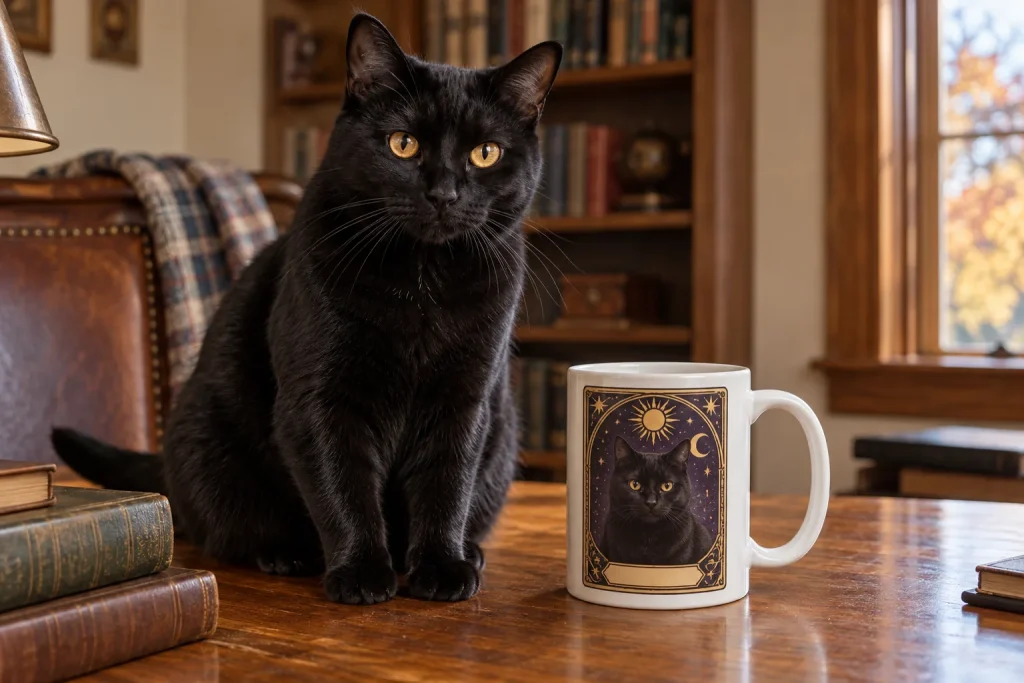
For a little mystic flair on your desk, the Cat Tarot Card mug puts your cat in the center arch of an ornate celestial tarot card, with gold line art, a sun, crescent moons and stars on a deep midnight-plum background. A personalized cat photo mug keeps it simple: your cat’s photo large in the center and the name below. For more ideas, browse our guide to black cat gifts. At Personalized Cat Gifts, you upload a photo, see a free AI preview (an illustration only), and our designers prepare the final artwork from the original photo and check it by hand before printing.
And if you like folklore, the Year of the Cat zodiac is another tradition where cats come out looking rather good.
Only in some traditions. In the United States a black cat crossing your path is often called unlucky, but in the UK and Japan black cats are traditionally linked with good luck, and in Scotland a stray black cat on the doorstep is said to bring prosperity.
It depends on the tradition. American folklore calls it bad luck, while in the UK and Japan it is traditionally a sign of good luck. In real life, it usually means a cat is on its way somewhere more interesting.
During the European witch hunts, cats were suspected of being witches’ companions or disguises, and the black cat became part of witch imagery that later shaped Halloween.
Some shelter studies found lower adoption rates for black cats, but researchers describe the evidence for a strong color bias as mixed, partly because many shelter cats are black.
Cats Protection in the UK celebrates National Black Cat Day every year on October 27 to encourage people to adopt black and black-and-white cats.
Questions about a photo or an order? Message us, we usually reply within 1 business day.